Showing posts with label Atheism. Show all posts

Thursday, August 15, 2013

Are atheists mentally ill?

That was the question posed by Telegraph blogger Sean Thomas, and he says "yes": I quote directly: "the evidence today implies that atheism is a form of mental illness."

So, what evidence is it that he speaks of?

Well, the piece was prompted by research which shows that generally, atheists are more intelligent than religious people (who from now on I'll call believers for brevity).

Before we go on I must paraphrase something I have written before:

We need to be clear that this research is not saying that atheists are smart and religious people aren't.

When talking about differences in populations, you're never far from cries of some sort of -ism, be it racism, sexism etc. This is because people tend to think of traits of populations as discrete points, and not overlapping bell curves. People misinterpret a saying like "Women are better at visual memory" as meaning that all women are good at visual memory, and all men are bad at visual memory.

Here's a simple example. Men are taller than women. Here's a graph to show this:


As you can see - men tend to be taller than women, but there is considerable overlap with their heights.

So it is with this research - atheists tend to be more intelligent than believers, according to a meta analysis of 63 studies that set out to answer that question. However, some atheists will be less intelligent than their religious counterparts, and vice versa.

Reading Thomas' article, I get the impression he is not aware of the above point.

Thomas decided to ditch measures of intelligence and instead chose to see how intelligently atheists and believers lived their lives. He says that believers:

i) have better mental health.
ii) live longer.
iii) have better immune systems and blood pressure.
iv) have better outcomes when going to hospital with broken hips.
v) have better outcomes from breast cancer, coronary disease, mental illness, AIDS and rheumatoid arthritis.
vi) have better IVF results.
vii) have lower suicide rates and ability to cope with stress.
viii) have more children.

All of which he says is true, even when smoking, drink and drugs are factored in (which, so we're told, believers do less of).

He also says that religious folk are nicer, as they give more to charity.

He hasn't linked to, or cited, his sources for all of this research, so I do not know its validity. But that is not important to my argument here, which is: even if all of that were true, it does nothing to demonstrate the truth claims of any religion. The reason I (and many other atheists) reject religion, is that there is not a jot of evidence for us to base any religious belief on. Thomas may not be aware of this concept too.

For me, assuming these data to be true, I would like to know what it is about being a believer that leads to these benefits, and can they be replicated for all (including believers - maybe some religions do better in some of the above metrics than others)? However, Thomas instead asks:

"So which is the smart party, here? Is it the atheists, who live short, selfish, stunted little lives – often childless – before they approach hopeless death in despair, and their worthless corpses are chucked in a trench (or, if they are wrong, they go to Hell)? Or is it the believers, who live longer, happier, healthier, more generous lives, and who have more kids, and who go to their quietus with ritual dignity, expecting to be greeted by a smiling and benevolent God?

Obviously, it’s the believers who are smarter. Anyone who thinks otherwise is mentally ill.

And I mean that literally: the evidence today implies that atheism is a form of mental illness."

This seems to be the "Ignorance is Bliss" argument for religion - which seems a slight twisting of Pascal's Wager. It doesn't matter if a religion is true or not, but I might as well believe in one for my health.

This argument cannot persuade me though - even if, as an atheist, I miss out on a heap of health benefits, there's not much I can do about it. There is still no evidence put forward to back up any religions claims, so it seems I shall have to stick to watching what I eat and exercising regularly.

Even if I just went through the motions and attended religious observances, I'd just be living a lie, which isn't helpful given my commitment to not lying.

Thomas follows his statement "the evidence today implies that atheism is a form of mental illness." by saying:

"And this is because science is showing that the human mind is hard-wired for faith: we have, as a species, evolved to believe, which is one crucial reason why believers are happier – religious people have all their faculties intact, they are fully functioning humans.

Therefore, being an atheist – lacking the vital faculty of faith – should be seen as an affliction, and a tragic deficiency: something akin to blindness."

This, however, is a very flawed argument. Donald E Brown has a list of "Human Universals", in which he lists all those traits that have been found in all studied human societies. Conflict, rape and weapons are all on that list. Just because our brains are hard wired for something, does not mean that that is necessarily a good thing. Which of these universals (and you can read the list here) do we need to have to be "fully functioning" humans, and which can we drop? Also, when it comes to our brains, we can do nothing to escape optical illusions like this (the green and blue in this image are in fact both the same colour):


Our brains can be easily fooled, as evidence by religious and supernatural belief also appearing on that list.

I'll just finish with some of the answers to my questions: What is it about belief that can improve ones health?

Well, some research has been done this, and I'll quote a couple of times from the excellent Epiphenom, which blogs about research to do with atheism and religion. There's plenty of research on health and religion over there, and, what's great is that every blog post links to the original journal that did the research, so you don't just have to take the author's word for it.

I'll just draw your attention to a couple:

Firstly, a meta analysis looked at what it was about being religious that led to health benefits.

"three factors that do not connect religion and health.
  • If you are a man, then it seems like being religious isn't connected to being more healthy - or if it is, the effect is quite small.
  • Intrinsic aspects of religion (belief in a god concept, religious/spiritual well-being, religious/spiritual experience, and religious motivation/orientation) have no effect on health.
  • Although organisational activities (such as going to Church) seem to have a big effect, non-organisational activities (prayer, meditation, or sacred book study) do not."
It turns out that the community aspect - turning up to church, has the benefit, not the beliefs per se.

Secondly, there was a study into health, religion and education, it found that "for the less well educated, the risk of dying goes down as church attendance goes up. As you would expect.

Surprisingly, however, for the educated the effect is exactly opposite! Educated people who go to church often are actually more likely to die young!"

So religion isn't quite the health tonic it was made out to be.

Also, charity and religion isn't as clear cut either. It also appears that the community side of religion promotes charitable giving. Religious people who go to church more tend to give more than religious people who go to church less.

It may be that us atheists can reap some of these benefits by being actively involved in a community.

Of course, if one is to look at societies as a whole, we see that atheistic ones tend to fair better.

Not bad for populations of people who live "short, selfish, stunted little lives".

Wednesday, August 22, 2012

Atheism+

Agnostics, Atheists, New Atheists, Gnu Atheists, Secular Humanists, Apatheists, Secularists, Secular Humanists, Anti Theists, Freethinkers.

There are a lot of labels given to people who don't believe in god(s). A lot of it comes down to semantics - by some people's definition, I'd be an agnostic (as would Richard Dawkins). I'm just going to use atheist from here on in though...

To me though atheism's not that important - I became an atheist by myself, the more I though about religion, the more atheism made sense. I only started proactively speaking out about it after reading books like the God Delusion which successfully argued (to me) that religion is, on balance, a bad thing for society. People are free to believe what they like - so long as it's not going to be detrimental to others.

It wasn't just me that became more vocal about atheism though - more books, blogs and media airtime was given to the subject. Groups of atheists got together online and IRL, and unsurprisingly, shared interests in skepticism, science and such.

Turns out though, that when you have a bunch of people who have strong views; prize independence of thought; and like to be vocal about it, you end up with a wide range of interests and views on what needs to be done. Hence the plethora of labels for atheists - people come to it for different reasons, have different goals, and different values about what's important. Who knew?

Well, there's a new name tag in town: Atheism+

"We are…
 Atheists plus we care about social justice,
 Atheists plus we support women’s rights,
 Atheists plus we protest racism,
 Atheists plus we fight homophobia and transphobia,
 Atheists plus we use critical thinking and skepticism."

I like it - as I said before, atheism wasn't important. It was only when I realised that religion is on the whole a bad thing that I started to speak out and do stuff about my atheism. To quote a famous vigilante "It's not who I am underneath. It's what I do that defines me".

It's a shame though that this new wave of atheist action has grown out of the flaming misogyny from too many in the wider atheist community. I've barely touched on the issue myself, mostly because I've not had time to deal with the vindictiveness that comes from when you do. I wish I did have the time - one can only stop things like this by speaking out. So I doubt I'll have the time to be actively involved in Atheism+, much as I'd like to. But I wish them luck.

Some may say Atheism+ is just the same as Secular Humanism - may be it is? But who cares - it's what they do that will define them.


Thursday, July 19, 2012

Atheism and love and science

Love is often used by religious apologists. Atheists like myself will point to the burden of proof resting on the religious believer, and they will reply that there's more to life than what can be proved by science such as love, and say things like "...science will never be able to prove that love exists, and it would be silly to ask that of science." The idea being that: science has nothing to say on love, and believing in love is fine, therefore, believing in god is also fine. (We'll ignore the faulty logic today). The thing is, science can say a lot about love (and religious claims for that matter, for example the efficacy of prayer).

Firstly, we have lots of evidence that love exists. We feel it and experience it - so there's something going on in the brain. There is ample evidence of the love between myself and my girlfriend, the love between my family and the love between my friends. Through the actions of those in a relationship, it's obvious to see when you are in a loving, and caring relationship, and also when you are not, by appraising the available evidence.

We can look at the physiology of people in love. Seeing someone you're in love with, or attracted to, can increase your pulse and breath rate. In fact, it can also work the other way around - meeting someone in a situation where your pulse and breath rate have been increased, can increase your attraction to that person in what's called the "misattribution of attraction". You're body is behaving as if it's aroused when you meet a person, and so you think it is that person that has caused the physiological response, not the other aspects of the environment. It's not the only case of acting "as if" you are a certain type of person, and then actually becoming that person.

Science can look at the hormones that are involved in love - for example oxytocin, often called the hormone of love, though it's a little more complicated than that (watch out, it has a darker side too).

Evolution can explain perfectly why love evolved - the love of a parent their child is understandable for the propagation of Homo sapiens, and other species (although parental care is not universal). Do other animals experience parental love for their children? One would presume less so in the sloth, who I've heard (but can't find a reference for online, and all my books are in boxes in a storage unit) leave babies that fall to the forest floor to die, as going to get them puts them at too much risk of predation. What about the love of a partner? In mammals, for example, testicle size correlates with monogamy, polygamy and harems. Gorilla's testicles are about 0.03% of their bodyweight, and they have harems. A gorilla doesn't need to produce much sperm, as it has control over who it mates with. Chimpanzees on the other hand have testicles that are 0.3%, and they are highly promiscuous - as the female chimps have many partners, a male chimp must produce lots of sperm so as to have higher reproductive success. Humans, interestingly, fall in between these two extremes with 0.08% of bodyweight being testicles.

It may be very difficult to find out if animals feel love, but certainly we can look at how they behave, and the biochemistry that's going on when they do and see how it matches up with what happens in us when we are in love. This is what makes science fantastic: Asking questions and being happy with the answer "I don't know" whilst working on a way to find out.Love is certainly within the realms of science, even if it has to take a different approach.

Now, some people might say that understanding love would spoil it. I will let Richard Feynman explain why I don't agree with that:


"I have a friend who's an artist and he's some times taken a view which I don't agree with very well. He'll hold up a flower and say, "look how beautiful it is," and I'll agree, I think. And he says, "you see, I as an artist can see how beautiful this is, but you as a scientist, oh, take this all apart and it becomes a dull thing." And I think he's kind of nutty.

First of all, the beauty that he sees is available to other people and to me, too, I believe, although I might not be quite as refined aesthetically as he is. But I can appreciate the beauty of a flower.

At the same time, I see much more about the flower that he sees. I could imagine the cells in there, the complicated actions inside which also have a beauty. I mean, it's not just beauty at this dimension of one centimeter: there is also beauty at a smaller dimension, the inner structure...also the processes.

The fact that the colors in the flower are evolved in order to attract insects to pollinate it is interesting -- it means that insects can see the color.

It adds a question -- does this aesthetic sense also exist in the lower forms that are...why is it aesthetic, all kinds of interesting questions which a science knowledge only adds to the excitement and mystery and the awe of a flower.

It only adds. I don't understand how it subtracts."

Friday, January 20, 2012

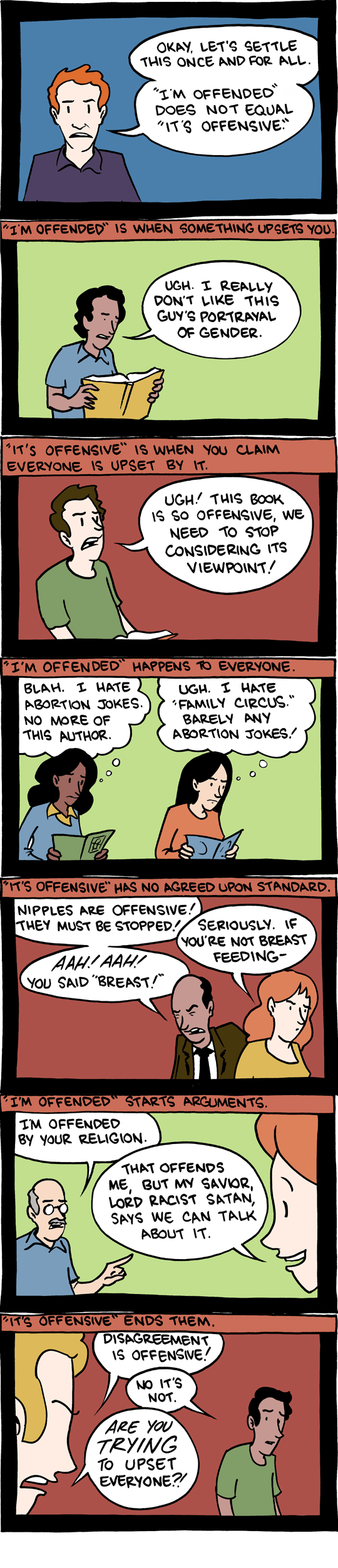
When atheists get offended...

Recent events made me think back to when some adverts were seen on the sides of London buses. They directed you to a website, which said that atheists (well, those that "exchanged the truth of God for a lie"), and (of course) homosexuals, deserve to die.

A rather offensive message, some might say, myself included.

How did we, the Militant New Atheists respond?

Did we threaten the lives of those associated with the buses the ads were on? 

Did we complain they were un-atheist?

Did we riot and kill people?

No. We got together, raised over £150,000 and made our own ads to express our own message.

You can't go through life with out getting offended, and, if you do - it's much better to attack the idea than those who hold it.

Friday, January 6, 2012

100 questions for the Christian believer

Piet was kind enough to drop by ask "To promote skepticism/critical thinking I wrote some questions for the Christian believer. Are you able to put the link to these questions at your blog".

Well, I'm happy to oblige, but...

Whilst I applaud the promotion of skepticism and critical thinking, I'm not sure how effective they will be, and don't really like the approach myself. The tactic is rather similar to creationists.

Years ago (before I discovered capoeira) I used to debate creationists online. Well, initially I'd respond to a genuine question regarding evolution. It was fun - I'd get to research and write an essay on some aspect of evolutionary biology. However, what would often happen would be that a creationist would come in, use copy and paste, and post over 100 questions/links to answers in genesis/some other creationist waffle.

It's not possible to answer all of those questions/points thoughtfully, or fully. If you don't answer them all, then the creationist will go "Ah ha! You couldn't answer this, therefore I'm right". You can't win.

Likewise, those questions are set up in a similar fashion, no Christian has the time to answer them all properly. I didn't even have time to read them all. They can't win.

I'm all for asking questions of believers (and for them to ask questions of me). But I'm not convinced this is the best way.

However, you can make up your own mind here:

The original questions
http://www.freethinker.nl/forum/viewtopic.php?f=31&t=8382
The translation
http://www.freethinker.nl/forum/viewtopic.php?f=31&t=10033

Friday, December 30, 2011

Does the Pope watch House?

Whilst I'm on the subject of Catholicism, this is quite funny.


The Pope in his Christmas Homily:

"if we want to find the God who appeared as a child, then we must dismount from the high horse of our “enlightened” reason."

Hat tip to Jerry Coyne.

Friday, March 18, 2011

Why am I an atheist? (In answer to Jerry Coyne)

I've answered the question before, in response to PZ, but I'd like to add a little more after Jerry Coyne asks: Why are you an atheist? Does it have anything to do with a lack of evidence for god, or are there other factors involved?

PZ's contention is that there can be no evidence for a god, period. Jerry argues, that, whilst none has been presented, it could be possible. This initial discussion led me to state "There is no god".

I side more with PZ, but I'm not going to stick my neck out and say there could *never* be any evidence for God. I strongly suspect this to be the case, but, my limited imagination could be at fault.

However, for there to be evidence for god, we do need to define what a god is, and what it does, and evidence for this. I strongly suspect that this will never happen. I'm almost absolutely certain this is so, but, and for all intents and purposes, you can remove that "almost". For me to be proved wrong will require a theist to get a coherant hypothesis, and, given the time that's been available, I can't see this happening.

So far, there aren't any decent arguments that I've seen. "Sophisticated" theology or not.

Tuesday, March 15, 2011

In which I disagree with Bishop Nick Baines

I'm super busy, but was in a queue so started catching up on blogs I've not had a chance to read. I also wanted to remind everyone about the Census Campaign from the BHA, and saw this criticism of it: Poor stupid people who need to be told what to think. So here's a super quick reply...

It appears the critics haven't quite grasped the campaign. Firstly, the Census Campaign isn't, as the Bishop says "against the ‘religion’ question", but it is actually for the religious question, by encouraging the accurate answering of the question. No one is telling any one what to think, just to answer the question honestly. If you're not religious, for God's sake say so.

Christianity is on the decline in the UK, despite what previous census data has said. However, as Johan Hari has pointed out: Which two nations still reserve places in their parliaments for unelected religious clerics, who then get an automatic say in writing the laws the country's citizens must obey? The answer is Iran... and Britain.

It's no wonder Bishop Baines is critical. It's also a pity he doesn't link to the campaign himself, only via the two posts he links too. I always think it's better to link directly to what you're commenting on, so people can make their own minds up. Kinda funny, given his title...

So, remember, you're not a Jedi, when it comes to the Census, if you're not religious, then say so.

Also, I don't know Nick Baines' opinion on homosexuality, but he seems to come a bit close to defending some bigots. We need a secualr society because if we indulge every religious whim it's every man for himself, given the mutually contradictory nature of the various religions out there. Just because you're religious doesn't mean you get to have a free card to be racist, sexist, homophobic etc etc. Nick Baines writes:
So, if you ‘believe’ that living according to the precepts of Jesus Christ is good or essential, you are supposed to keep your ‘belief’ in the realms of opinion. But, if you ‘believe’ that no negative  judgement should ever be made about any other practice or lifestyle, that is a ‘belief’ that can be given free rein. Is that not weird?
No, it's not weird, and I don't think any one is saying that "no negative  judgement should ever be made about any other practice or lifestyle". People are welcome to their beliefs, but not to be openly bigoted.

Wednesday, February 2, 2011

In answer to PZ part 2, in which I disagree with him a bit

PZ Myers asked "Why are you an atheist?" and went on to describe some of his peeves with atheists. In my last post I answered with why I'm an atheist, and will now point out where I think PZ's wrong to be peeved. It is this bit:

"Babies are all atheists or I'm an atheist by default, because I was raised without religion. Nope. Uh-uh. Same problem as the Dictionary Atheist — it implies atheism is simply an intellectual vacuum. Babies aren't Christians or Muslims or Hindus, and they aren't atheists, either, because we expect at least a token amount of thought is given to the subject. If babies are atheists, then so are trees and rocks — which is true by the dictionary definition, but also illustrates how ridiculously useless that definition is.

Babies might also have an in-built predisposition to accept the existence of caring intelligences greater than themselves, so they might all lean towards generic theism, anyway. Mommy is God, after all.

There are a fair number of adults who ought to know better who insist on the dictionary definition, too. They've been brought up without god-belief, and some of them may not have even considered religion much at all. Unless they are real lightweights, genuine feathers adrift in the wind, they also carry a set of values that incline them towards godlessness…otherwise you'd expect them to fall on their knees and turn Christian the instant they first hear about Jesus. They don't, and why? Probably because they learned some critical thinking skills from their parents. They carry positive values that make them resistant to the cheap promises of faith."

I would actually like to see an increase in this category of atheist.

Granted *right now* you'd be a fool to say religion isn't important in the world. However, I think it would be great to see more people raised godless, who don't really consider religion at all, and get on with their lives, in the same way, that lots of people don't believe in ghosts, or the Bermuda triangle, or crystal healing. There is a lot of nonsense floating out there, and there are not enough hours in the day to take a serious look at it all.

I would like these people, when pressed, to explain they've never considered it as it's just ridiculous nonsense, and it would be great if this could be the way the majority of people are raised.

This is easy for me to say though, Britain is already, or at least getting close, to the point of religious types being in the minority.

I think it is the above type of atheist that help this. At school, I was very interested in religion (well, still am), but a lot of people just didn't bother considering it.

As the BHA highlights, there's still plenty of work to do in becoming more secular. Also, I don't think the States are ready for more of these atheists, as, if they're not considering religion, then they won't be considering such issues as atheism in schools and such.

However, ultimately, I'd like these people to be the norm. A man can dream...

Why I'm an atheist. In answer to PZ (Part 1)

PZ asked Why are you an atheist?

I wrote this on Facebook before my blog, which does answer PZ:

A little on what I beleive...

There seem to be some misapprehensions about my beliefs and thoughts about religion. So, to clear things up, here's brief note on what I believe. I say brief, but it’s obviously going to be quite long. But it’s a big subject. Also, please use the comments if you disagree with me, but at least read all of this before you do. I’m writing this in my lunch hour off the top of my head, and haven’t the time to search for links etc, so if I make claims, but haven’t given the evidence, just ask, and I’ll back up my assertions.

Firstly, I don't think religious people are stupid because they're religious, I think someone is stupid, if they're stupid. Said stupid person could be an atheist. I do think religious people are deluded. Sadly, this has negative connertations, but I'm not sure what other word to use. The same has come for ignorance. Neither of these mean that someone is stupid. I think that a religious person is deluded, because I think their religious beliefs are wrong (factually, potentially morally, but that very much depends on the individual’s beliefs). This shouldn't be insulting though - even with the up most respect for others’ beliefs, a Christian for example, will quite clearly think a Hindu is deluded, or indeed that I am, for not accepting Jesus Christ as their personal saviour. Why do I think religious people are wrong? Well...

I used to be a Christian (C of E), I would go to Sunday school regularly (Blandford Camp’s Rainbow Club), though it was a very casual religious upbrining. At school I took extra religious education classes – religions interest me. I left the Rainbow Club, as, after a few years, it got a bit boring going over the same Bible stories. At school I began my drift away from belief. I’d ask questions, and not get answers – for example, I can remember being fobbed off to rubbish answers to my questions. For example, if God wants everyone to be a Christian and praise him, couldn’t he have put a little more effort in than sending Jesus to the Middle East, and then letting a bunch of murderous religious zealots spread it to the rest of the world? (I can’t remember my exact phrasing, but I mistakenly showed my poor geography by placing the Middle East in Europe in my question. The answer to my question he gave highlighted that I had got that bit wrong, and was left at that. There wasn’t an actual answer to my question). The obvious question about a “God of the gaps”, as another example, was just rephrased back at me. Alas, if I was me now back then, I’d have been a bit more forceful and asked for an answer, as it was, I got my rubbish answer, and meekly replied yes. You live, you learn.

So, the more I thought and asked, the more religion didn’t seem to make sense, and just seemed made up. By the time I left school I was an atheist. I was quite quiet about it though (unless asked, or in an actual religious debate), but, after 9/11, and then when I read Sam Harris’ and Richard Dawkins’ books on religion after uni, I became more vocal.

I don’t dogmatically stick to atheism though. I just want a reason why I should believe a certain religion. Because I say “I don’t believe that” does not mean I’m saying it’s impossible, I just want evidence.

So far, I have seen no evidence for any religions, but I have seen evidence for how religions can be explained as a psychological product of the mind. If I was given good evidence for a religion, I would change my mind.

I can also state what kind of evidence I would be looking for. (Whereas I’ve found religious people can’t say what kind of evidence would make them change their mind about their beliefs).

Stuff like this would be good: If the chances of catching a disease at Mecca were reduced, or at least the same, as people's day to day living. As it is, pilgrims at Mecca are at more risk of disease, as one would expect from so many people in so small an area.

Someone praying for an amputee, and their limbs coming back, would also be good evidence.

These things are not evidence: Religious texts - the Bible contradicts the Qu'ran and vice versa. If you accept one, why not the other?

Personal revelation is also out – you may very well be sure you experienced something, but there are countless others from other faiths, who have had their own revelations, which contradict yours. If you are religious, and think you have evidence, imagine someone of an entirely different religion who had similar evidence to yours. Would it convert you?

I hope you get the idea.

I don’t believe that rejecting propositions for lack of evidence makes me closed minded.

I am against religion. This is because from all that I have seen so far, religion appears to be nothing more than a quite elaborate superstition, that is very widely accepted. That’s not why I’m against it though. Whilst I do acknowledge that there are good parts of religions, I feel that on the whole, religions are a Bad Thing for society. Dogmatic views can lead to bigotry (for example religious homophobia), holding back scientific progress (for example stem cell research), just wrong on so many levels (the stoning of raped women to death for adultery) and, well, 9/11. Yes - that last example is from a religious extremist, but without the moderate take on religion, you wouldn't get the religious extremist. I know this wouldn't solve the problem, as nutters are nutters, but it’s a start. I forget the exact quote, and who said it, but “Good people do good things, and bad people do bad things, but for good people to do bad things, you need religion”.

Religions are also, by their very nature, divisive.

That said, I do believe in religious freedom - people should be free to believe what they like (though acting out these beliefs should have restrictions when they impinge on others). For complete religious freedom, one needs a secular society. The laws of the land should not favour one religion over another, this would not be fair. Laws should be decided on the merits of the issue at hand, not from centuries old religious dogma from nomadic goat herders who didn’t even have concepts of a lot of modern day life. So, for example, I think that halal and kosher meat is inhumane, and shouldn’t be exempted from the animal welfare laws on slaughtering animals.

Whilst I am for religious freedom, I am intolerant of some religious beliefs. For example, the whole hoo ha by the Catholic adoption agency over letting gay couples adopt – not based on any evidence of whether children raised by straight couples do better than those raised by gay couples, for example, but solely because of their ingrained religious homophobia.

Whilst I know that religions are deeply held personal beliefs, and that discussing them may cause some one to be uncomfortable or offended, I don’t thing that that’s a good reason not to discuss them. If people can have their political views etc challenged, why not their religious ones? Obviously, there’s a time and a place, and I do admit to getting the time and place wrong, but I’m a Bear of Very Little Brain and far from perfect.

People say that Science is my religion, but I will have to disagree. Here’s why:

Published science gets into journals via peer review. When a paper is submitted, it is reviewed by other people, independent of the research, who are also knowledgable on the subject, to determine if the paper is up to standard. As with all systems, this one has its flaws, but it’s the best thing we’ve got at the moment (feel free to offer an improvement here). Once it is published, it is then open to the criticism of everyone. Poor papers get knocked down, or stand up to the onslaught, and our knowledge moves forward.

From this, we get theories. A scientific theory is not the same as a hunch. It’s our current, best understanding of the information available. They are open to debate, but some theories can be seen, essentially, as true beyond all reasonable doubt.

For example, that bacteria can cause disease, is “just a theory”, germ theory. Likewise, the theory of evolution, is “just a theory”, but it is true. How do we know? There are 150 years of evidence to back it up. Yes, it is true that something might come along and disprove both of these – as with any other theories, but nothing has yet. If I’m to not believe in evolution, or that germs cause disease, then I want some pretty outstanding evidence.

Believing in scientific theories is not religious. It is not dogmatic, it can move forward, unlike religion, which has changes because of it – witness geocentrism. Galileo was right, though the church said he was wrong. Indeed, the Pope said that whilst Galileo was correct in his assertions, the Churches actions were the right thing to do.

That said, people can stick to “scientific” beliefs dogmatically, look at the odious Andrew Wakefiled spinning bucks of his discredited, and demonstrably incorrect, assertion that vaccines cause autism.

Science is wrong all the time, and says so. However, as it moves forward, it becomes increasingly more right. Back to evolution as an example, the central concept of random adaptions being non-randomly selected is good, but there are debates about the gene centred view, kin selection etc. This drives it forward, and enhances our understanding. As evidence of science moving things forward, I offer what ever device your reading this on – be it a computer, mobile or whatever.

If science knew all the answers, it would stop. Religion claims to know all the answers (God did it).

The Bible doesn’t change, nor do other religious texts – people may reinterpret, or change existing views to accommodate new evidence.

Now, I have been called a fundamentalist atheist, but I’m not sure how any of this is fundamental. I’ve also been told that, as a fundamentalist atheist, I have radical and extremist behaviours, and adhere to a set of beliefs. Again, I’m not sure how that above lines up with this. I hardly call engaging in (albeit it at time heated) discussions, tweeting, or writing notes on facebook as radical and extremist. If you’d like to enlighten me though, I invite you to do so in the comments below.

If you really want to make a comparison between me and religion, you’re better to chose my support of Manchester United (but I’ll not hear a word against the Holy Trinity of Ferguson, Giggs and Cantona) : P

Thanks for reading!


I've since changed in stance slightly, and go so far as to say there is no god.

In my next part, I'll disagree with PZ's post a bit.

Friday, November 12, 2010

Improving on Mother Teresa

Famous Mother Teresa Prayer- The Final Analysis Prayer

People are often unreasonable, irrational, and self-centered. Forgive them anyway.

If you are kind, people may accuse you of selfish, ulterior motives. Be kind anyway.

If you are successful, you will win some unfaithful friends and some genuine enemies. Succeed anyway.

If you are honest and sincere people may deceive you. Be honest and sincere anyway.

What you spend years creating, others could destroy overnight. Create anyway.

If you find serenity and happiness, some may be jealous. Be happy anyway.

The good you do today, will often be forgotten. Do good anyway.

Give the best you have, and it will never be enough. Give your best anyway.

I saw this prayer today, and if it could end here, it would be quite a nice little set of aspirations. The last line spoils is:

In the final analysis, it is between you and God. It was never between you and them anyway.

Do good for goodness' sake. It seems to me far better to just do good things for no reward other than it's the right thing to do. Doing good just because you're hoping for a reward at the end is hardly the most noble of intentions.

Also, what we do is about "us and them". I really dislike this notion that what we have here, right now, isn't really that importnat, it's the afterlife that really matters. It seems like such a wasteful world view. What we do here matters, and our actions do impact on each other.

So, instead, I'd much rather have this as the last line:

In the final analysis, this is the only life you have, so you'd best be excellent to each other. And don't let the bastards grind you down.

Friday, October 22, 2010

Atheists around the world

Well, following posts on Pharyngula about groups in Greece, Cyprus and Kampala, I thought it'd be pretty cool to get all of these tagged on to a map, and then we can see them all over the world.

So, here we go: Atheists around the world

Feel free to email me englishatheist@gmail.com with your group, and I'll get them on.

Atheist blog roll

Further thoughts for the day has has been added to The Atheist Blogroll. You can see the blogroll in my sidebar. The Atheist blogroll is a community building service provided free of charge to Atheist bloggers from around the world. If you would like to join, visit Mojoey at Deep Thoughts for more information.

Us atheists in the UK have quite an easy time to be honest, as a country we're becoming more secular, but in the States and other places it's harder. I think that online communities like this are useful, at TAM I met some folk who loved being around like minded people IRL, but were thankful of the online atheist community, as it gave them some sanity when they were lone atheists amongst their colleagues etc.

Thursday, October 21, 2010

Andrew Brown, missing the point again

Andrew Brown has had an attempt at satirising Gnu Atheist arguments, substituting "human rights" for religion. He gets off to a bad start with his first sentence being entirely wrong...
The essential point about human rights is that there is no evidence whatsoever that they actually exist.
Sadly, given that there is a wealth of evidence for the evolution of morality, and thus human rights, and so, the nail has not been hit on the head. For a nice satirical piece, it's best not to start with an entirely false premise, and base your argument around it, unless you're supposing that what you parody is as equally false. Unfortunately, the rest of the article is so stupid it burns, as it is essentially a case study in how Andrew Brown fails to see the point of almost every Gnu Atheist argument, or doesn't like us asking for evidence.

Is it so bad for atheists to say "I've not seen any evidence yet, please could you show me some? (Not this kind).

It's also true that children are born religion free, and only learn to have a religion from their parents (backed up by the uneven distribution of religions acros the globe). When this point is made in paragraph three, it's all the more ridiculous as children do actually learn to play fair by themselves when they're not even two years old, also religious indoctination can be a form of child abuse.

PZ Myers "courtier's reply" is also mentioned, it argues that one needn't be a top tailor to reject the Emperor's new clothes. Again, we're back to Andrew Brown not liking evidence.

I'll repeat the last paragraph:

I know that some people will be shocked by this argument. It's all very well, they will say, to dismiss God, or religion in this way, because those are things that other people believe in, and they are silly, and nasty, and wrong. That's why they're other people. But to demand evidence that the things exist which we believe in – that's absurd. 
But, I, and the atheists I have met, have all been skeptics, wanting evidence for everything.

I'm also baffled at how someone sees wanting evidence as a bad thing. How else can you evaluate things? How else could you learn new things?

In the comments he added:
zdenekv:
But one should look at what actual philosophical theories which deal with this issue say instead of just assume ( as Andrew does ) that there isnt anything sensible that can be said about rights.
Well, that is the assumption of this article. It is not my real position, of course. There are sensible things to be said about rights, just as there are about god. But in both cases, a demand that we start by proving their existence excludes all the interesting possibilities.
Evidence doesn't exclude interesting possibilities, it makes things even better! As Richard Dawkins said at TAM: "Science is the poetry of reality".

The truth really is stranger than fiction.

And it's awe inspiring!

And it's exciting!

And it's true.

(We know because we have evidence).


.


Wednesday, October 13, 2010

I believe there is no god

Yes, I have shifted from "I don't believe in God" to "I believe there is no God".

I've been quite busy of late, so am only just catching up on blogs and such (and with TAM on the horizon, will be out of the blogosphere a bit more).

Any how, when I first read PZ saying "There is no evidence for God", I thought, that's not very scientific. We've not seen any evidence, but that some won't come along.

Jerry Coyne had similar, and better expressed thoughts, and challenged PZ that there must be some evidence, that, if presented, would make him agree.

Well, PZ has replied with "Eight reasons you won't persuade me to believe in god".

It's convinced me: There is, as far as I'm concerned, no god.

This also highlights one of the things I like about an atheistic/sceptical world view over a religious one: Changing one's mind when presented with a better argument/evidence etc.

Now, I might (but doubt) read a reply from Jerry, or in the expanding number of comments on PZ's piece, that makes me change my mind.

This is, of course, in stark contrast to dogma that is always right, even if it's wrong.

I never thought I'd change from "I don't believe in god" to "I believe there is no god", as, before reading that post, it seemed most unscientific. But, you know what? There is no god.
Related Posts Plugin for WordPress, Blogger...